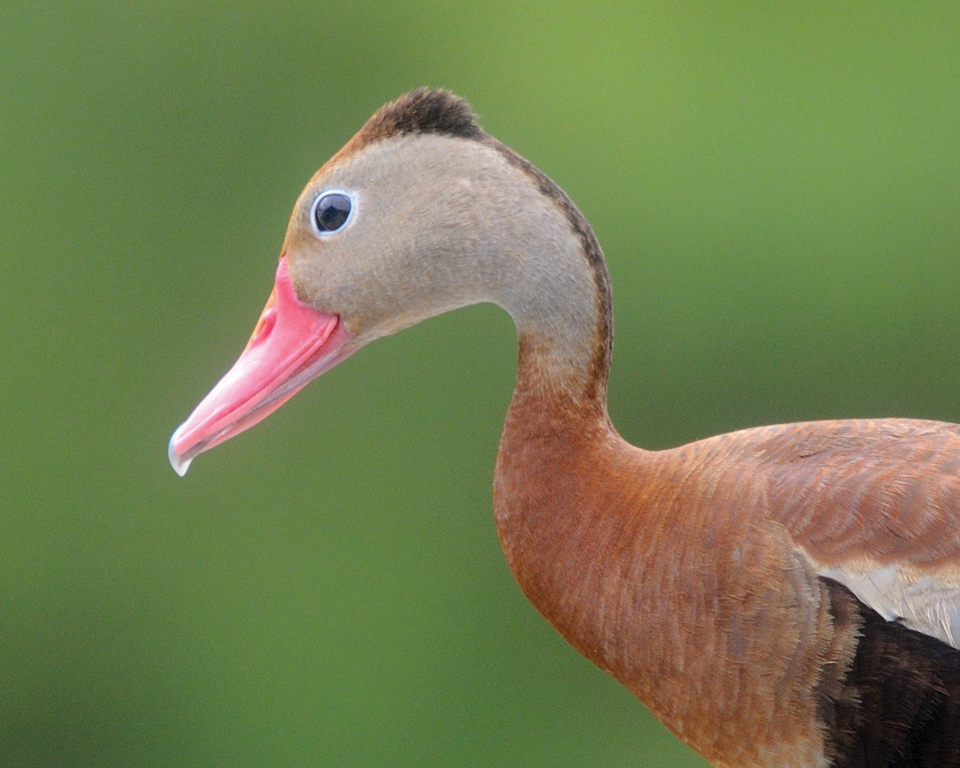
A collection of little pink legs, stick-like and long, crisscrosses rapidly back and forth amongst each other, visible underneath the fence boards. Every few seconds, a pink bill also appears, pecking the ground for corn and other grains left behind from the sloppy horses’ mouths. Peering over the fence board, the rest of the ducks’ bodies reveal themselves — brown and gray and unlike any duck I have seen in this area up until now.
Though not much of a bird watcher or duck hunter myself, I’ve learned to identify a few species second hand from the men in my life. Mallards, of course. Every Southerner is born recognizing those, if only from the patch on the back of a man’s khaki pants. I know the blue bills who migrate through the Causeway every fall, as well as coots, gadwalls and others. But these gangly things, walking through Baldwin County pasture land like miniature geese, are the new duck on the block.
The group of 20 or so birds seems less timid than many wild ducks, and only moves off en masse when I get fairly close. While it might be the abundance of free grain on the ground, avian experts at Mississippi State say that tameness is also a personality trait of the black-bellied whistling duck, whose range is now expanding east into coastal Alabama and up into the Midwest. The birds once made their homes in southern Texas, southern Arizona, and Central and South America, but their range has been expanding in recent years and, as the abundance of little pink legs would indicate, can now be found in large gaggles across Mobile and Baldwin counties. Though shallow wetlands and marshes are their natural habitats, golf courses, farm fields under seed and, as I am discovering, horse farms, are popular substitutes if water and food are available there.
In late July, I first saw the family of birds from the back of a horse while riding through fields that contain a small pond bordered by cypress trees and full of lily pads, algae and a patch of dollar weed that erupted after the summer drought left portions of the pond floor exposed. The ducks were eating leftover grain from the mares’ pasture — two adult black-bellied whistling-ducks and 12 little hatchlings all in a row — but they moved into the pond for protection when they saw me coming. One adult duck led the little ducklings swiftly into a floating mass of pond grass for hiding, while the other adult stayed a safe distance between me and the little paddling family.
Over several weeks, the ducklings grew into gangly teenagers and, before long, the adults were either nowhere to be found, or were indistinguishable from their brood. Legs got long and pink, and colorful bills punctuated a flurry of movement and pecking.
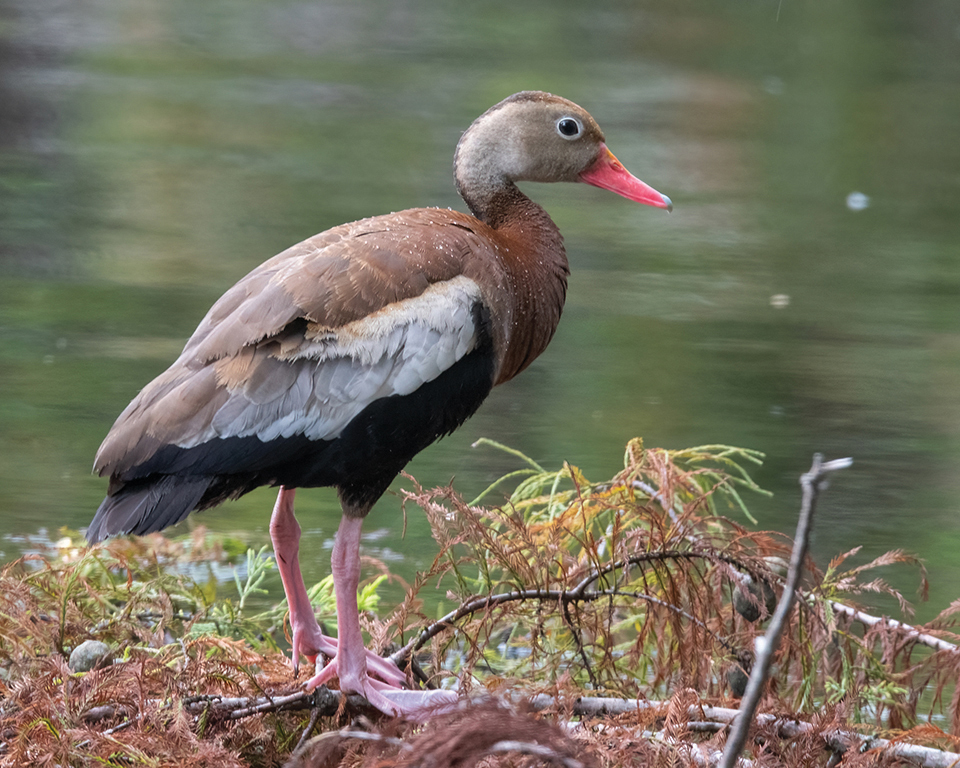
According to Jonathan Pérez, associate professor of biology at the University of South Alabama, the birds are scientifically more closely related to geese and swans although they are broadly considered ducks. “Their unique looks and behaviors blur the lines between what it means to be a duck or a goose. Whistling ducks branched off before the common ancestor of modern geese, swans and ducks. Meaning, whistling ducks are evolutionarily older than modern geese, swans and ducks and comprise a unique branch on the waterfowl family tree.”
Sam Fishman, a coastal biologist with Alabama Audubon, says the black-bellied whistling duck has characteristics common of both ducks and geese, and they certainly catch your eye when perched on a fence post, garden lamp or other man-made structure, as they are known to do.
The ducks are sexually monomorphic, meaning there is no difference in appearance of the males and females, and they tend to mate for life, like a goose. (By contrast, ducks tend to mate for a season.)
“They are cavity nesters like a wood duck,” explains Fishman, “but not exclusively. They will also nest in chimneys, barns or dense vegetation if cavities or man-made spaces are scarce.”
He says they are the living embodiment of the old adage, “Don’t put all your eggs in one basket.” “Females will egg dump, meaning they will go into other females nests and lay eggs.” Called brood parasitism, this strange habit actually leads to increases in the success rate of hatching according to research by Mississippi State University. Males and females share equally in the duties of finding and preparing a nest, sitting on it and rearing the hatchlings, as well.
By late September, many of the black-bellied whistling ducks in Mobile and Baldwin counties will have moved on to greener (and warmer) pastures. But if the last few seasons are any indication, they’ll be back.