Brothers Abraham and Joseph Neisner founded a five and ten-cent variety store in Rochester, New York, in 1911. Another up-state entrepreneur, Frank Woolworth, had opened his “Great Five Cent Store” in Utica in 1879. By 1913, New York’s Woolworth Building was the tallest in the world. There was money to be made in nickels and dimes.
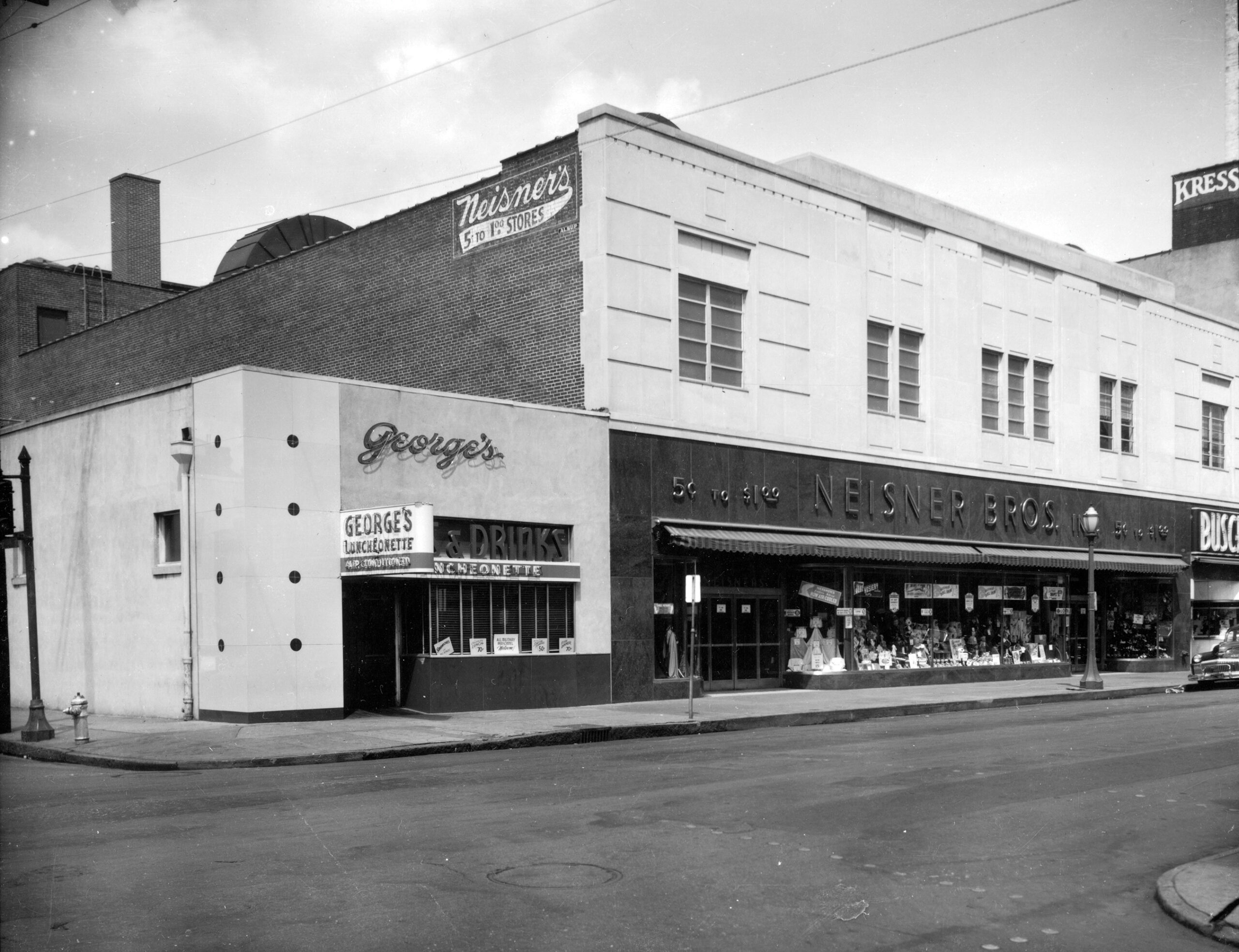
The Neisner brothers operations expanded steadily. By 1947, both brothers had died, and the company was led by their two sons. Mobile’s location at 22 South Royal opened its doors in October of that year, bringing the number of Neisner’s to 116 stores in 17 states. National sales that year reached $50 million (roughly $725 million today).
The new building with its distinctive curved show windows contained Mobile’s first “bargain basement.” At the north end of the building was a separate commercial space which was leased to Busch Jewelry Company. And beyond the jeweler was another variety store known for low prices: S. H. Kress and Company
From Quality Clothes to Hamburger Sandwiches
When Neisner’s opened in Mobile, their price range had jumped to an advertised high of $5 but period ads reveal that was not always the limit. In 1947, Mobile women could select dresses priced from $4.98 to $7.98 while slips could be bought for $1.17. Men’s “first quality shirts” were $1.88 while their boxer shorts would run 54 cents.
Household goods ranged from bath towels at 37 cents each to a pet canary for just $1.59. The chain found success as a comfortable place to find a bargain and a bite to eat.
In the days following the store’s opening, newspaper ads invited Mobilians to “meet and eat at Neisner’s Luncheonette” where they were offered “Southern fried chicken, buttered kernel corn, fluffy mashed potatoes, a roll and butter” for just 50 cents.
A day or two later, hungry shoppers had the choice of homemade meat loaf (45 cents) or a “large size hamburger sandwich with an ice cold root beer” for a mere 15 cents.
Neisner’s was a generous employer. The chain pioneered employee profit sharing programs, group insurance, retirement plans, vacations and bonuses for all their employees. They made headlines in 1955 when every 25-year employee of Neisner’s received a $1,000 bonus (over $12,000 today).
By the 1960s, Neisner’s re-branded themselves as a “Variety-Junior Department Store.” And within seven years, there were 192 locations in the United States, but trouble was coming.
Free Parking is the Winner
Mobile, like countless other cities, was experiencing a revolution in retailing. Springdale Plaza had opened in 1959, offering seemingly endless acres of asphalt for free parking. Then, in the summer of 1967, the luxurious new completely air-conditioned Bel Air Mall arrived with even more free parking. And a competitor, K-Mart arrived in a big box with what else — loads of free parking.
The change in downtown Mobile was seismic. Every major retailer headed west where much of the population was already living by that time. The few that held out did not survive. The last listing for Neisner’s appeared in the 1969 city directory. With so many downtown retailers experiencing similar moves across the nation, it is not surprising to find that Neisner’s filed for bankruptcy in 1977.
In Mobile, their former building was vacated and Busch Jewelry decamped to Bel Air Mall. A home furnishings store briefly occupied the building before the U. S. Social Security Administration leased the space from 1972 to the mid 1980s.
Today, the building survives thanks to Ralph Hargrove. It has been handsomely restored as office space and improved with balconies overlooking the Mardi Gras parade route. The entrances retain their distinctive curved windows as well as that mosaic memorial to a forgotten retailer.
Interestingly, the flagship Neisner’s in Rochester has been also been repurposed into a luxury apartment building offering amenities that range from a fitness center to a dog spa.