Aubrey Alison Bishop Jr. was a pilot, and a good one — a pilot’s pilot. He was a B-24 flyer in World War II and operated reconnaissance planes on the East German border during the Korean Conflict. He flew fixed-wing aircraft and helicopters.
Such skills were vital for landing an aircraft on the Dauphin Island Bridge.
He landed his L19 Birddog on the then-under-construction thoroughfare over saltwater because he wanted to. Sometime later, he landed his helicopter on it after dropping a coin at the toll booth as he hovered.
However, on his second landing, someone called the authorities, who said, “Don’t do that anymore.” He did not.
“wild and free.”
The skilled and accomplished pilot seized the day, every day. Such was life in the 1950s pre-bridge era. For the 200 villagers who called this home, Dauphin Island was Dodge City with an ocean view.
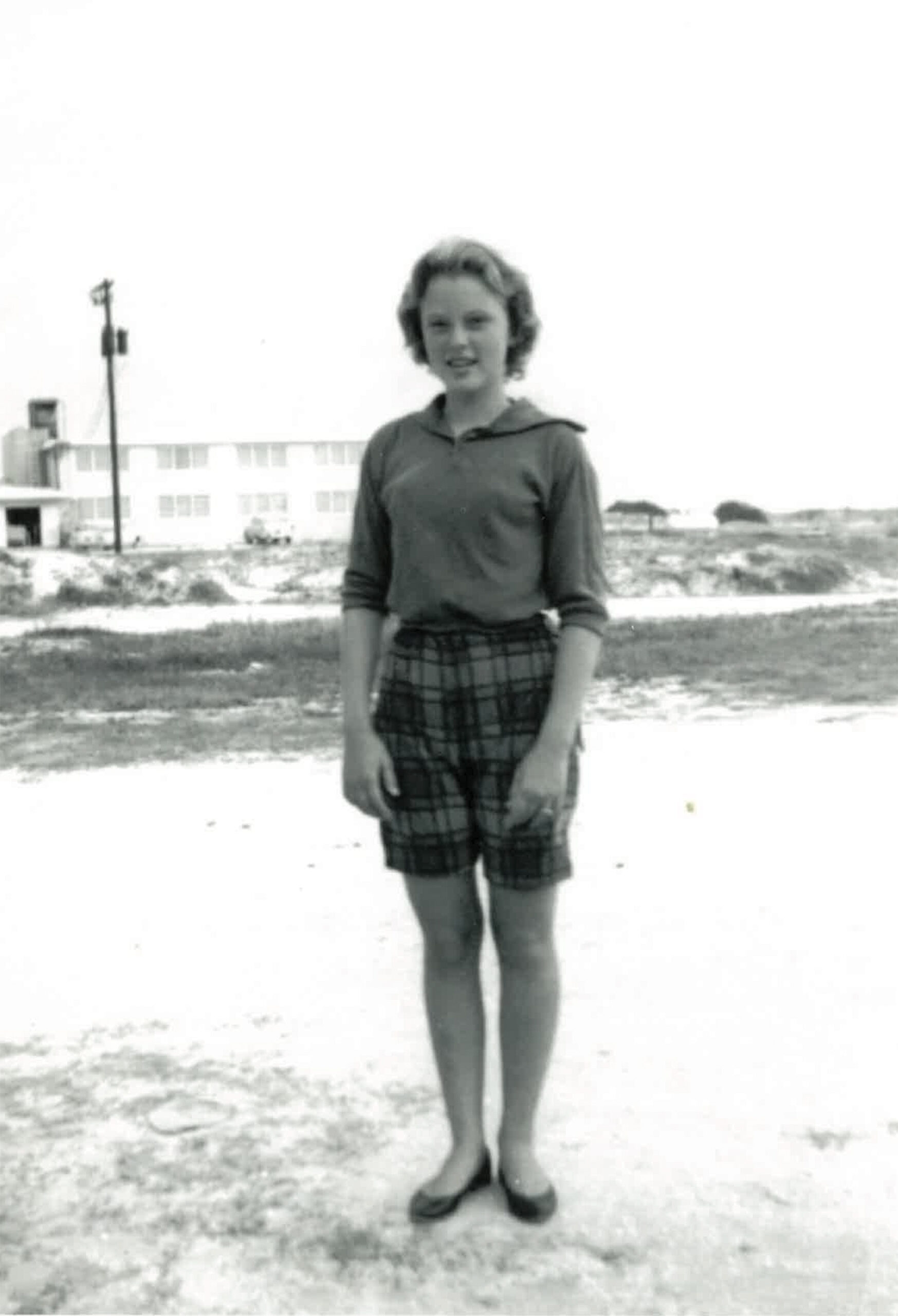
“We lived in a different era of culture, attitude and environment back in the ‘50s,” says Aubrey’s daughter, Sherry Bishop. “The island was wild and free and, as children, we lived in, explored and became part of the natural world.”
For much of the ‘50s, there was no bridge. Villagers visited Mobile by boat as needed. But they always returned to their island paradise. “Everybody knew everybody,” Sherry says. Recalling childhood adventures, she adds, “We fished, crabbed, collected oysters and rode go-carts all over the island.”
Children visited friends and local businesses. The youngsters had charge accounts at Ship N Shore, Isle Dauphine Club, the Ice Cream Parlor and Marina Restaurant. Parents paid off the balances each month.
This was a land of sand dunes the size of houses. Goats nested in low-hanging tree limbs, and cattle meandered throughout town and beach.
Aubrey loved it. “Daddy had an instant attachment to Mobile and Dauphin Island,” Sherry recalls. “He was born in Tibbs Community between Memphis and Nashville and never liked his Tennessee roots, which he called, ‘an accident of birth.’”
She adds, “He spent his youth in Tennessee, but as soon as he was able to leave, in his 20s, he ‘corrected that mistake and moved home to Mobile.’”
He was employed at Brookley Air Force Base before World War II and afterward until the base closed in 1969. During this early time in Mobile, he learned of Dauphin Island.
When military service ended, and the shackles of Tennessee were forever broken, he returned to Brookley as the superintendent of aircraft. He also discovered the ‘wild and free’ Dauphin Island with frequent family trips via oyster boats or flying over in his L19 airplane.
On this 1950s isle of wonder, children traveled in goat-drawn wagons, and sea turtle eggs were more than nature’s marvel — they were tasty. Sandbars filled with those casting for fish. Night bars filled with those casting for beverages requiring identification.
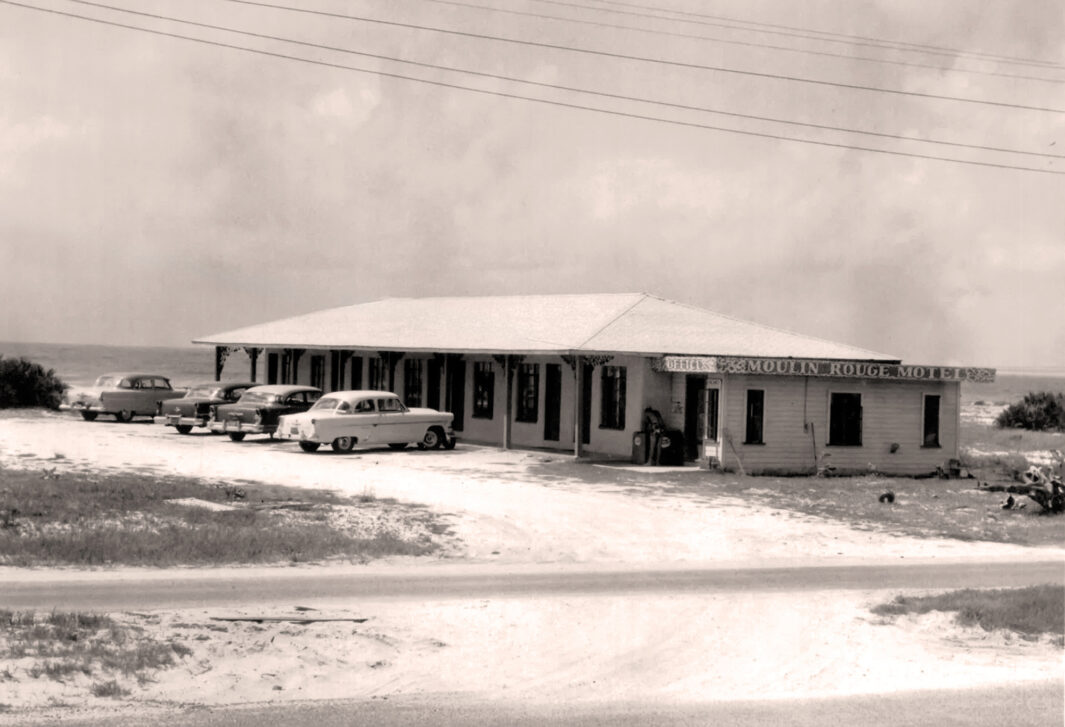
Seeing the potential of this poorly accessible saltwater land tract in the Gulf, Aubrey built Dauphin Island’s first motel, the Moulin Rouge. “Daddy was fond of Paris, which he saw during the war,” notes Sherry. He named his motel after the Parisian cabaret of the same designation.
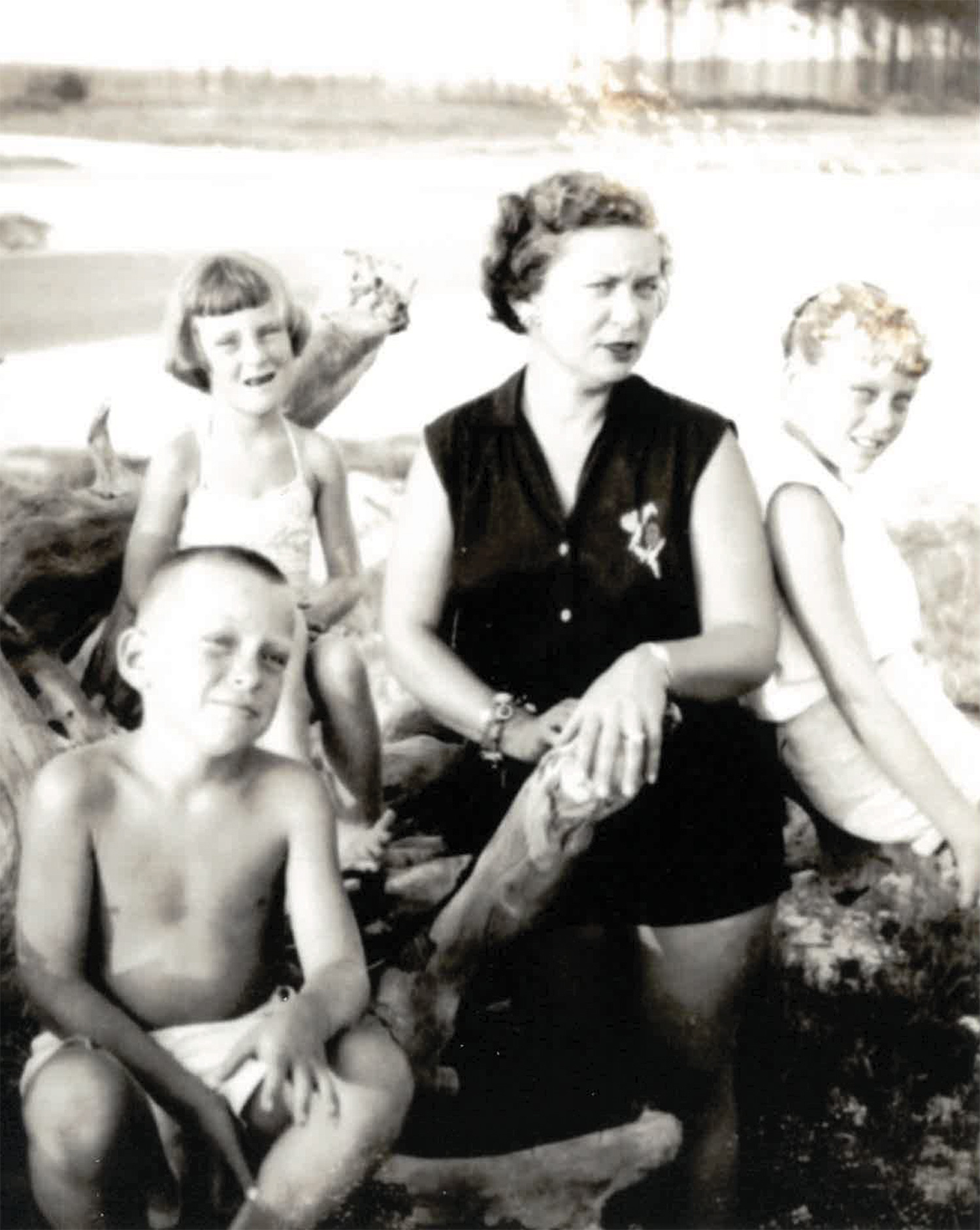
The Moulin Rouge housed seven rooms. Two were for the family: One for Aubrey and wife Doris and the other for the children — Sherry Bishop, Ava Bishop Barbour and Aubrey Bishop III. Five rooms were for guests. The family spent summers on Dauphin Island and the other seasons in their home in Mobile.
Located on Dauphin Island’s west side, the motel was painted bright pink. The Moulin Rouge was more than an inn; it was a maritime navigational tool.
Sherry recalls, “Shrimpers used to tell us, when they were offshore, the one thing they could spot was that blip of pink on the sand. When they found the shoreline’s pink dot, they knew where they were.”
Life was good for Aubrey, known to all as A.A. (Double A) or Bishop. He offered flights for neighbors and friends. Most had never been in an airplane or a helicopter before.
“I never got to fly with him,” says Justine Bixler, the youngest of Aubrey and Doris’ five grandchildren. “I always thought it was so cool, our parents experienced this with him.”
Flying to and from an island with no airport was an art form. Aubrey would take off and land from anywhere he wanted, but a safe descent was an art form.
In a Mobile Press Register newspaper interview on February 3, 1994, Aubrey explained his technique. “The trick to landing on the island, especially the beaches, was to touch down near the surf on the wet sand, hard and compact. Softer sand farther from the water looked safer, but the softer sand would dig you in and curtail your activities for a while,” he laughed.
Other activities awaited Aubrey when coming in for a helicopter landing inside the walls of Dauphin Island’s Fort Gaines. He heard what he thought was his chopper blades striking nearby shrubbery. Unfortunately, it was not. Shots were fired, and a three-pointed love triangle lost a point. Aubrey rendered aid to the dying man, but his life was lost.
Asked about the event in a 1994 interview, the pilot recalled that in those days (the early ‘50s) Ft. Gaines was wide open. He noted, “You could walk around anywhere in it, day or night. It made a great hideout.” Usually…except not for one man.
There were also animal encounters. A herd of cattle grazing the island included over a dozen cows devoted to their leader, Butterfly the Bull. Butterfly was named for the markings on the great beast’s muscular body, not for a dainty insect. He was far from dainty.
The bull of distinction was a foe best left alone, as one man learned the hard way. He was part of a team to capture Butterfly and remove the bull from the island. Butterfly disagreed.
Once confronted, the bountiful bovine focused its attention and horns on one unlucky individual. With the bull charging, the chosen poor soul ran for his life, seeking shelter behind a tiny tree offering little protection. Butterfly’s horn caught the would-be captor’s belt loop, ripping his pants clean off. The bull left the man in the woods with stories to tell, but not that day, as he was clad in underwear only.
Another islander favorite was the fishing rodeo visited by locals and, at times, celebrities. At age 9, Sherry met U.S. heavyweight boxer Rocky Marciano when he attended the rodeo to see a boxing match. The famous boxer had a pleasant conversation with Sherry and gave his autograph. The Deep Sea Fishing Rodeo Queen, Joyce Van Tassell, also signed her book in August 1956.
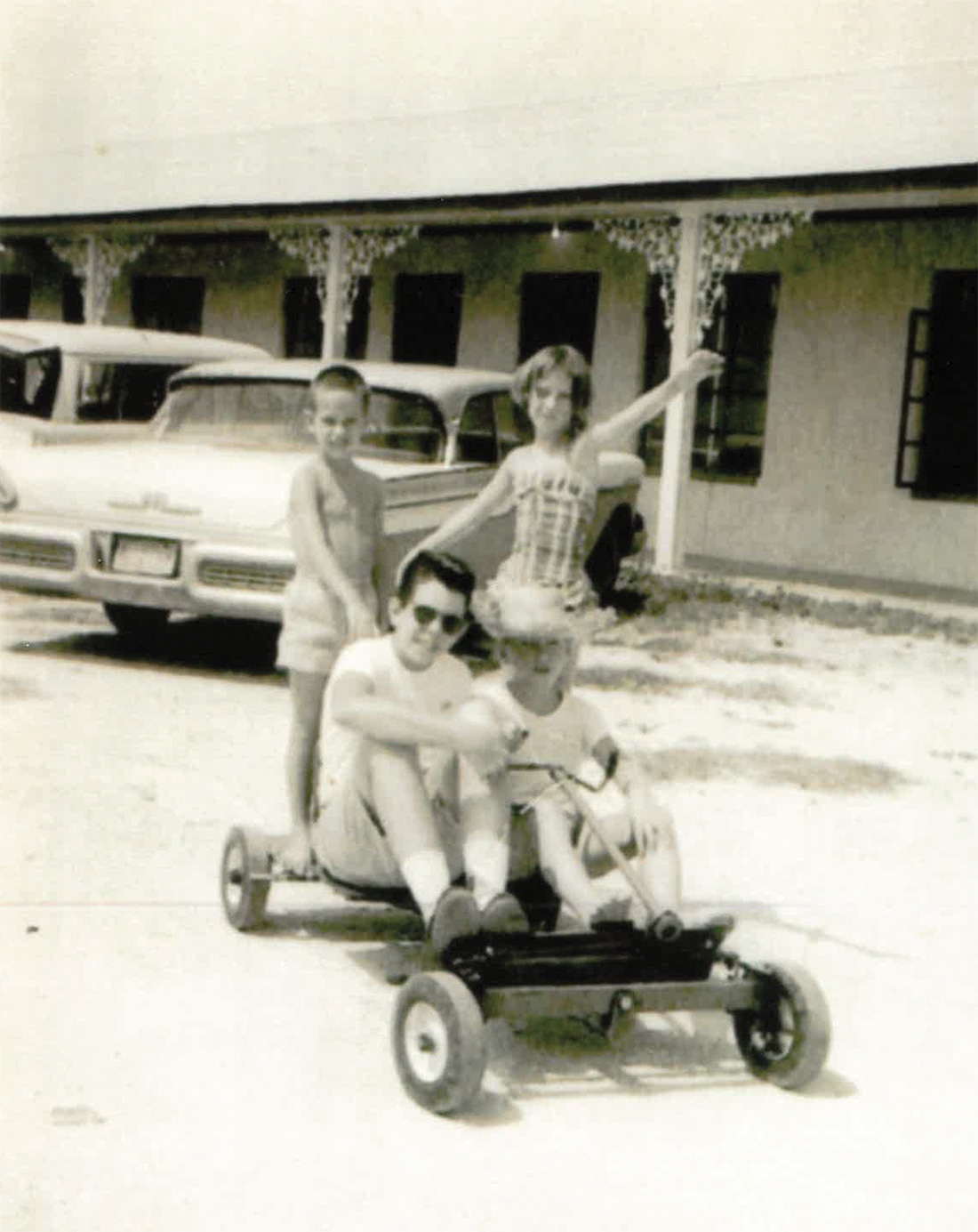
Island life included beach combing and managing the motel as a family in the largely untamed paradise.
On July 2, 1955, Dauphin Island’s Bridge opened. The village in the sea linked with Mobile and beyond. The event was a bittersweet moment where a carefree lifestyle met hectic progress.
Today, Dauphin Island thrives with over 1,000 residents. It is a tourist attraction with thousands of visitors and commuters traveling the bridge that was once just a dream.
For those who lived in the rough-and-tumble island frontier, the dreams live on.
“I think of families passing down their stories, life lessons and history,” says Justine. “I imagine what island life was like back then when we visited the goat trees, searched for Indian arrowheads in the shell mounds, fished and knee surfed down sand dunes by the Isle Dauphine Club.”
She adds, “We left no part of the island unexplored. Those are some of my fondest memories. I feel very connected to Dauphin Island.”
Sherry adds about her beloved island, “This place is part of who I am.”
The Moulin Rouge was sold in the early 1960s and later bulldozed. No trace of the island’s first motel remains today. Shrimpers no longer have “that little blip of pink” guiding them home.
On August 15, 2008, Aubrey Bishop Jr. died. He was 90. His wife, Doris Bishop, died April 9, 2013. She was 90.
The dream of the Moulin Rouge started when Aubrey was 38 and Doris, age 32 — blazing a trail and leaving a family legacy that runs deep to this day.
The aviator’s obituary reads, “He has now stored his plane in the hangar on the field where flyers go.”
Justine notes, “I still have the compass from my grandfather’s plane. It’s in my China cabinet. I occasionally look at it and pretend I was there.”
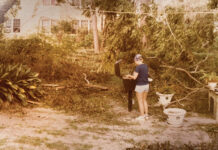
The old Dauphin Island hotels and restaurants came and went with the weather. The Island Casino was swept into the sea by Hurricane Camille in 1969. The Holiday Inn and Capri were destroyed by Hurricane Frederick in 1979. The bridge was also obliterated during Frederick.
A new one was put in its place, with construction ending in 1982.
But strong winds and earth-moving equipment cannot remove the memories of those who lived here during its “Dodge City” days. For those who called it home, its authentic spirit forever remains “wild and free.”