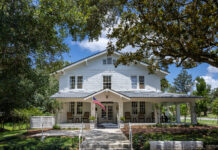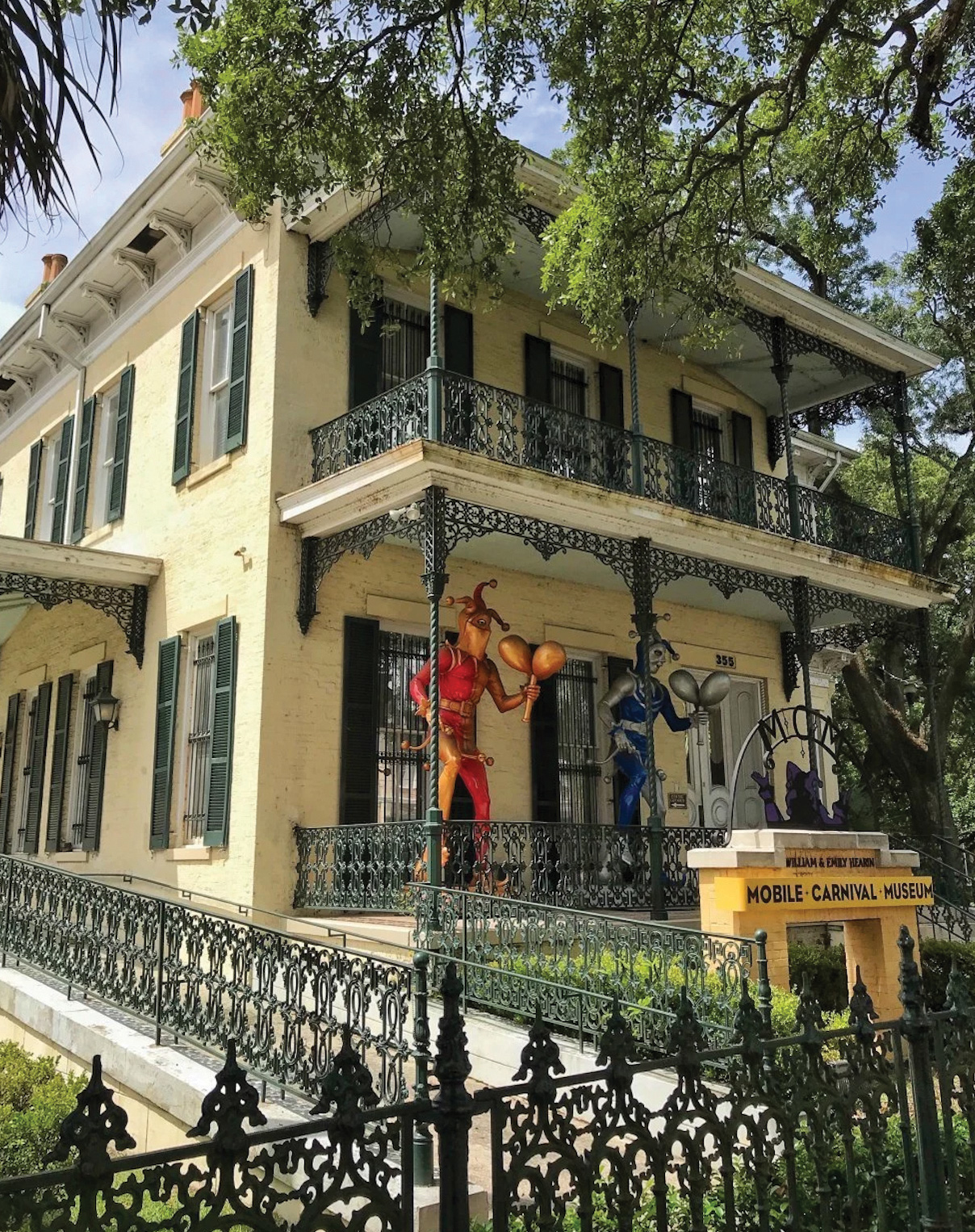
What is formally known as the Bernstein-Bush House dates to 1872 and was designed by Mobile architect James H. Hutchisson for Henry Bernstein, who had a wholesale business selling boots and shoes. Business must have been good because, in 1872, he signed a contract with the architect to construct a brick house for the sum of $15,250, or close to $425,000 today.
There were not too many substantial houses built in the decade following the end of the Civil War, and the Bernsteins’ new abode certainly must have become an immediate landmark on the southeast corner of Government and Franklin streets. The two-story home featured Italianate flourishes such as the low-pitched roof with its decorative scrolled brackets. The cast iron supports on the front gallery are tall, slender and twisted.
Henry’s wife Bertha died in 1888, and he ultimately moved to New York City to be near his daughter and son. At least one daughter remained in Mobile, as well as his brother, Lyman, who was in the retail shoe business on Dauphin Street.
In the April 3, 1896, edition of the New York Times, it was reported “Henry Bernstein died in his home in New York on Saturday, the same date that his brother died in Mobile, Ala.” Henry’s body was shipped back to Mobile and buried in what is now the Spring Hill Avenue Temple Cemetery.
A Mayoral Residence
By the time of the demise of the two Bernstein brothers, the house at 355 Government Street had been owned by cotton factor John Curtis Bush and his wife Ruth since 1891. At that time, Bush was in partnership with his brother Thomas in the firm of J. C. Bush and Co. Mobile’s city directories place Thomas as also residing here with John and his family. John Curtis Bush had become president of the Mobile Cotton Exchange in 1887 and would hold that position for a decade.
The 1900 U. S. Census revealed that 355 Government Street was occupied by John and Ruth Bush, their five children ranging in age from 17 to 28 and two female servants. Bush listed his occupation as “Mayor.” He had been elected in 1897 by a large majority, and during his terms in office, he was lauded for obtaining municipal ownership and improvements to the water system and bringing the city’s finances to greater efficiency.
In addition to his extensive public service, Bush was a director of the Mobile Chamber of Commerce and three insurance companies. His financial support largely assisted with the construction of the new First Baptist Church on Government Street, which was completed in 1906. This replaced that church’s hurricane-damaged former location on St. Francis Street.
A Brilliant Reception
In December of 1903, one of the Bush daughters, Sarah, married Augustus William Brooks at the St. Francis Street Baptist Church at an 8:30 p.m. service with a reception following at 9:30 p.m. The news account noted that “a brilliant reception in honor of the young couple was held at the handsome Bush home at 355 Government Street.”
In June of 1910, newspapers around the state reported that “John Curtis Bush died at the family home after an illness that dates back a number of years.” Following a funeral in the parlors at 355 Government Street, the former mayor was buried in Magnolia Cemetery.
His widow remained in the house until 1922. By that time, a gasoline station was operating a block to the east and a car dealership was being built beside the Government Street Presbyterian Church within view from her front porch. Mrs. Bush moved to Los Angeles to live with a daughter and she died there in 1940 at the age of 84.
40 Years of Funerals
Bush sold her home to Frank Roche, who had been operating Roche and Burke Undertaking Company with Peter Burke Jr. on the northeast corner of State and St. Joseph streets. Interior changes were made to the house, including the removal of the spiral staircase and the replacement of the carriage house with a garage for the hearses.
Burke died soon after the business moved into the mansion. A year later, the business name had changed to Roche Undertaking Co. and had the words “Funeral Home” added to the title. Americans were slow to stop having family funerals in their own homes, and the industry was doing its best to change that.
Roche Funeral Home successfully operated on Government Street for nearly 40 years. By the early 1960s, the bulldozers of the urban renewal program had arrived Downtown, and the blocks south of the business were being razed for the auditorium complex. The entire block of homes to the west was destroyed to create Spanish Plaza, and businesses were fleeing downtown for the Beltline and the new malls.
Abandoned
After Mr. Roche’s 1962 death, his partner, James J. Duffy, followed the trend and built a new facility on the west Beltline between a recently extended Dauphin Street and Airport Boulevard to the south. Meanwhile, 355 Government Street sat forlornly vacant for nearly a decade.
In 1972, 50 years after it had become a funeral home, a new purpose was found for the historic structure. Through the efforts of Emily Staples Hearin, a generous grant was obtained from the Chandler Foundation and, together with government funding, the building was restored to house the new Museum of the City of Mobile.
When that entity moved into the former City Hall, the building was restored once more in 2005 to become the current Mobile Carnival Museum, which has been named for benefactors Emily and William Hearin. That museum relies on no city funding and successfully showcases the colorful history and traditions of Mobile’s carnival season to visitors from all over the world.
Another Mardi Gras Connection
The home in which John Curtis Bush lived and died is now forever linked to the city’s Mardi Gras history. But John Curtis Bush had another link to Carnival. The home he grew up in at 252 St. Anthony Street has been the den for Mobile’s oldest parading organization for decades.
Mobile Carnival Museum • 355 Government St. mobilecarnivalmuseum.com