“Hell hath no fury like a woman scorned.” Although that old adage from William Congreve’s play, “The Mourning Bride,” is normally attributed to matters of a rejected romance, it may also be associated with the rage of a woman whose family is suffering from critical shortages of food and clothing. Just such a hardship was best demonstrated during the American Civil War as the naval blockade of Mobile Bay resulted in continually rising prices and shortages of daily necessities until the discontent finally erupted into a riot on September 4, 1863.
Beginning in the winter of 1861, the blockade resulted in shortages and high prices for the average Mobilian. Items such as pork, beef, flour and coffee were becoming a luxury that only the wealthiest Mobile families could afford. As the war dragged on, Mobilians had to look to the interior regions of Alabama and Mississippi for food. But that supply was insufficient, partly because the war effort required the Confederate government to divert the crops produced there to feed the armies in the field. Furthermore, many of those fields were lying fallow because the men had gone off to fight, and the women were simply unable to manage the crops. Adding to the blockade were other supply problems. The prices were rising and the value of the Confederate currency falling, resulting in many instances of extortion and profiteering by unscrupulous merchants. This presented a crisis for Mobile’s women trying to furnish food and clothing for their families, and the level of discontent seemed to be in inverse proportion to the wealth of the people experiencing it. Even at times when goods were available in the city stores, the prices were so exorbitant only the wealthy could afford them.
State and city governments attempted to regulate prices through various commissions. But most of those efforts failed. As the number of indigents grew, wealthier citizens tried to alleviate the problem by forming cooperatives such as the Mobile Supply Association, purchasing food and supplies and selling the goods at cost. Well-to-do women joined together to help provide food and clothing to the less fortunate through the Female Benevolent Society. After dealing with a riot in Richmond, Virginia, the Confederate government attempted to create commissaries in each state to collect, store and distribute goods, but this was only minimally effective. Nothing seemed to work. Prices continued to skyrocket. Butter selling at 50 cents a pound when the war began increased to $5 a pound. Molasses, originally costing 30 cents a gallon, rose to $7 a gallon. Flour may have represented the greatest rise in price, going from $45 a barrel to $400 a barrel. Some food items soared as high as 750% over costs.
Mobile’s ladies tried their best to adapt to the clothing shortage through innovation. “All the rag bags have been emptied, and dresses turned into and cut in all kinds of shapes,” wrote Kate Cumming in her wartime diary. “Any and everything is the fashion: nothing is lost.” Other necessities, such as coal and wood for heat, were scarce. The former, although abundant in Alabama, was impossible to get, and the latter was priced at $60 to $70 a cord. “Nothing is cheap,” Kate continued. “I sometimes think we will be charged for the light of heaven and the air we breathe.”
The majority of Mobile’s women supported secession in 1861, and throughout the war, some wanted their men to fight on at all costs, as evidenced in a letter from a Mobile woman to her husband. “I would rather die than submit,” she insisted. Many others, however, were weary of the deprivations, feeling that resistance was futile, and longed for an end to the war. Incidents of desertions increased as a result of letters received by soldiers fighting miles away, containing pitiful pleadings from their wives such as, “Can’t you please come home . . . There is no money, and our children are hungry.” Women’s efforts to survive the war often ended in hopeless despair from pillaging. When they planted vegetable gardens to feed their families or sell at the local markets, hungry rebel soldiers stationed in the suburbs raided the gardens, plundering what little they raised. “It is useless to attempt to raise vegetables, for the soldiers will allow nothing green to sprout without pouncing on it,” complained one frustrated gardener. Gardens, however, were not the only prey for the pillaging troops. “Scarcely a day passes,” reported a Mobile newspaper, “without our hearing of some chicken coup, pig pen or larder being robbed.”
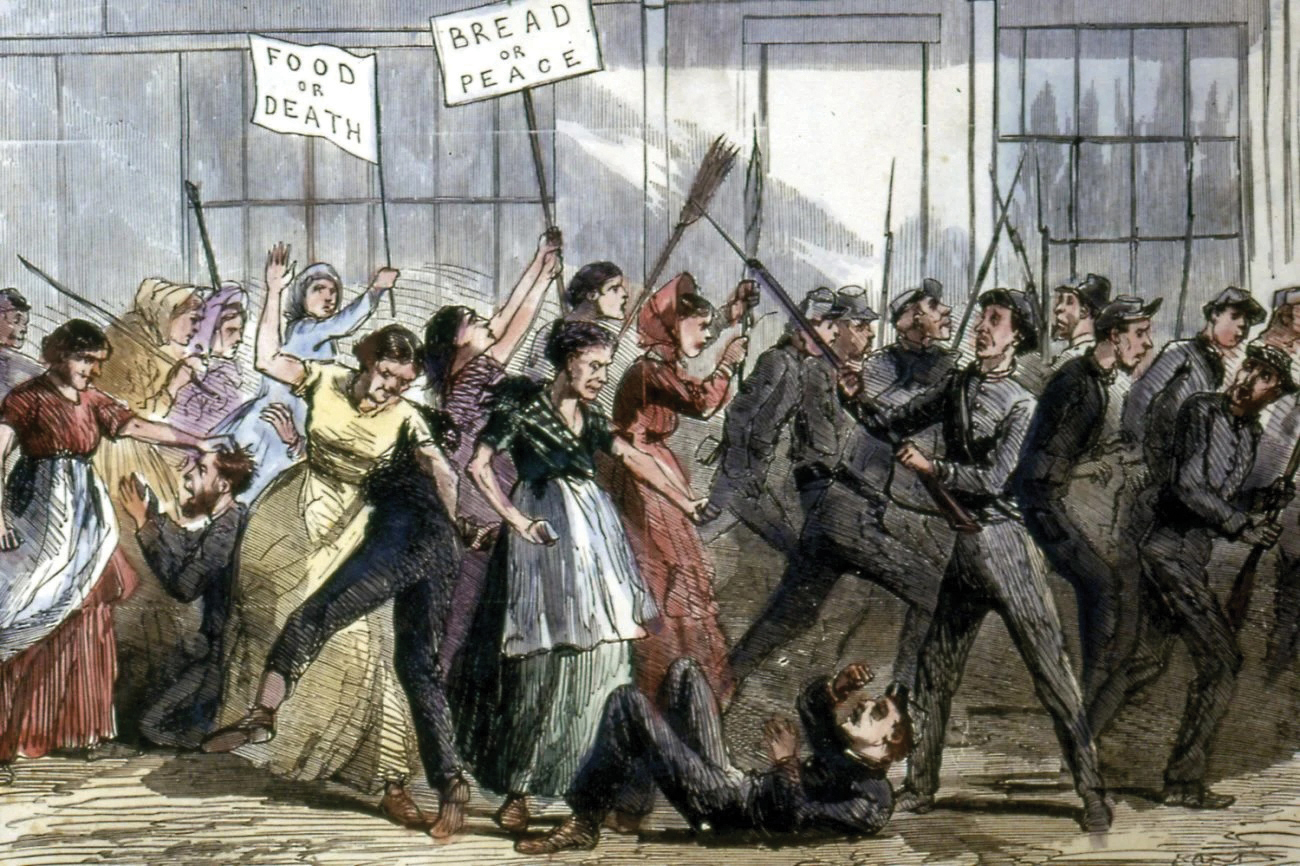
With subsistence becoming impossible, Mobile’s women were reaching their breaking point. As prices continued to soar, no one was surprised when city leaders became concerned over the possibility of violence. As feared, it erupted on the morning of September 4, 1863. Hundreds of distraught women gathered on the Shell Road, now Springhill Avenue, lifting signs and banners that read “Bread or Blood,” and “Bread and Peace.” Shaking their fists under the banners, many were armed with hatchets, axes, broom handles and bricks, all parading towards Dauphin Street with the intention of breaking into the stores and helping themselves to their family’s needs.
Sympathetic onlookers watched as the women broke windows and forced their way through doors, taking food, clothing and household items of all descriptions. Many of the stores were owned by Jewish merchants, who experienced the worst of the destruction and looting due to the prejudicial assumption that they were responsible for the inflated prices. In an effort to put down the riot, General Dabney Maury dispatched the Seventh Alabama Regiment to quell the vandalism. The soldiers, however, refused to obey his order, feeling compassion for the starving mothers and daughters, while knowing their men were off fighting the war. As a last resort, Maury ordered the Mobile Cadets, young teens belonging to a local military company, to put down the disturbance by force. They tried but failed, prompting a New Orleans newspaper to humorously satirize the event as “quite a little scrimmage [resulting] in the repulse of the gallant fellows.”
Without the success of a military intervention, Robert Slough, mayor of Mobile, could do nothing but appeal to the rioting women for a peaceful solution. In haste, he made an urgent speech to the ladies, promising to provide for their needs if they would disperse. Considering the city coffers were nearly empty, he knew it was an empty promise. Thus, that same day, Slough called on the citizens of Mobile, pleading with them: “Their own wants and those of their children are calculated to touch the hardest and least sympathetic heart. Let us then, my fellow citizens, see that these worthy objects of charity are placed above the reach of absolute destitution.”
Mobile’s citizens nobly responded to the crisis of the mayor’s appeal. Some contributed money to buy food and clothing for the needy. Others helped by distributing those goods and soliciting funds for the future. In the months that followed, Slough appointed a Special Relief Committee and encouraged the formation of the Citizens Relief Association, which surveyed the city, locating poor families to determine their needs. However, the supply shortages continued throughout the war and well into the period of Reconstruction. Although the city’s “Bread Riot” came quietly to an end, the women of Mobile had done all they could to solicit the altruism of the public and persuade those who were able to assist those in destitution.