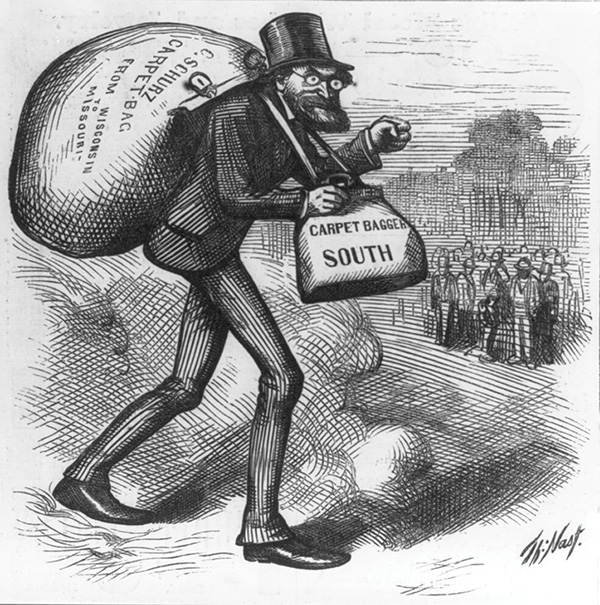
An 1872 cartoon depiction of Carl Schurz as a carpetbagger that appeared in “Harper’s Weekly” by caricaturist and editorial cartoonist Thomas Nast. Photo courtesy Wikicommons
After four long years of Civil War, a despairing gloom veiled Mobile. “The city is a sad picture to contemplate,” lamented a northern paper, while the Mobile Tribune agreed, deploring it “the most desolate of cities.” Once among the nation’s most prosperous cotton ports, trailing only New Orleans, Mobile had taken on the quietness of a ghost town. The economy was ruined. The population was depressed, reduced to widows, orphans, refugees and emaciated soldiers returning from the war. Initially, it seemed like Mobile was more fortunate than Atlanta and Vicksburg, cities reduced to rubble from constant cannon fire. Such optimism, however, was lost after a huge explosion occurred at an ordnance warehouse, storing captured Confederate ammunition and weapons. Caused by the careless handling of explosives, the huge blast left most of the northern half of the city in flaming ruins and damaged or destroyed many buildings.
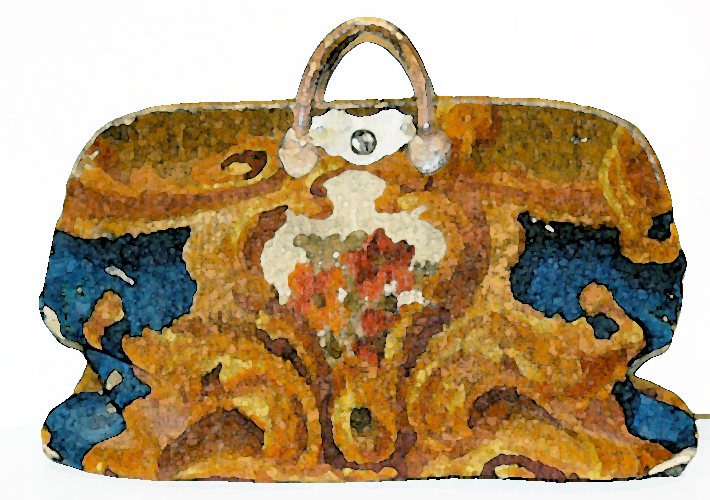
Following the catastrophe, thousands of Northerners streamed into the city. They were known pejoratively as carpetbaggers, seeking economic opportunities at the expense of a defeated people. Among them was a 26-year-old man with the distinguished name of William d’Alton Mann, who one spring day in 1866 made his appearance in Bienville Square. Young William had already served as a colonel in the Union cavalry during the war, and was lauded a hero of the Battle of Gettysburg. Unlike most carpetbaggers, Mann possessed considerable wealth from inventions he patented for use by the Union army. Adding to his royalties, the Federal government had named him to the position of tax assessor in Mobile. As a man of means, he checked into Mobile’s best hotel, the Battle House, where he remained throughout his years in the city.
Colonel Mann’s chances of being socially accepted by Mobile’s citizens were nearly impossible. Not only was he a former Union officer and carpetbagger, he also held the satanic position of Mobile’s tax assessor, controlling property taxes of an impoverished people with the power to seize and sell any abandoned property owned by former Confederate soldiers. Consequently, during the difficult days of Radical Reconstruction, men like Colonel Mann found themselves mercilessly ostracized and scorned by most of the citizens. Women would cross the street to avoid passing them. But if forced to pass one, they would sweep their skirts aside “as if to avoid contagion.”
Nevertheless, Mann was determined to be accepted by the city he had chosen to adopt, declaring, “I had always close to my heart a deep sympathy with the Southern people in their sufferings and deprivations.” Thus, he decided to go to Mobile, and with his money, “cast my lot with its people” to rebuild the city and get Mobilians back on their feet. A supreme bargainer, Mann was intoxicated with his desire to acquire fortune and fame. But he was charmingly likeable and, in turn, he wanted to be liked. Hence, Mann cleverly identified with Mobile’s people, raging against intrusive carpetbaggers — even though he was one. His first Christmas in town, he gave a dinner party at the Battle House, inviting some newly-made friends in the newspaper business. The Colonel understood the “power of the pen.”
At this time, there were four newspapers operating in Mobile: The Register and Advertiser, the Times, the Tribune and the Evening News, all of which were in financial predicaments. Mann acquired the Mobile Times in 1866 when it was on the brink of collapse. “The editors of the three [remaining] papers were friends of mine,” wrote the Colonel. “I accommodated them with loans until I had quite a bit invested.” The following year, the loans had grown to an amount sufficient to purchase the papers and retire the editor’s debts. Mann then combined the four operations into a single paper, The Mobile Register, which ran a morning and evening edition. Mobilians were understandably concerned that a paper owned by a carpetbagger and Union colonel would not represent their interests and ultimately become an instrument of the Radical Republicans. But Mann immediately dispelled their worries, announcing he was entirely in accord with the conservative political philosophy of his predecessor’s papers. In fact, he made it more so. The Register became the bastion of Southern resistance. Southern journalists pointed to Mann’s paper as a model. In addition to local and national editorials demonizing Radical Republicans, he added a New York fashion column, human interest stories and even a humor column, persuading Mark Twain to be a regular contributor. “I succeeded,” he recalled, “in making a paper which at that time had a wider circulation and deemed more important than any other published south of Louisville.”
In his role as tax collector, the Colonel found opportunities to make friends instead of enemies. That was soon apparent when authorities in Washington accused him of diverting funds owed the Treasury Department. Mann never denied the charge. But his defense counselor answered their claim, making it clear the dollars had remained with the citizens. “There are many merchants in this city,” wrote his lawyer, “who know Colonel Mann saved them thousands of dollars that… would have been filched from them had a Radical malignant held his place.” Such benevolence only increased Mann’s image as a true friend of the people of Mobile.
That image was further enhanced in May of 1867, when a delegation of Northerners led by Congressman “Pig Iron Kelley” came to Mobile to encourage the newly enfranchised Black voters to support the Republican Party in local elections. Mann’s paper wasted no time condemning Kelley as a troublemaker in its editorials. Kelley confronted Mann, demanding a retraction. Without getting one, he went ahead with his speech at a public gathering. As predictable, the crowd became hostile, and a riot ensued between Black and white citizens, leaving three men dead and 10 wounded. Kelley and General Pope, military commander in Mobile, condemned Mann’s newspaper as responsible for the riot. But Mobile’s citizens blamed Kelley as a racial agitator, and thanked the Colonel for revealing it.
Throughout this time, Colonel Mann was infatuated with money-making ventures, promising to yield huge fortunes for himself and the city of Mobile. A kinetic sort, his brain buzzed like a beehive with ideas. In addition to newspapers, he invested in a number of industries, with railroads being his main interest. “One of Alabama’s greatest capitalists,” according to the Mobile Board of Trade. He established a cotton seed oil refinery, which became the largest one in the country, and encouraged Mobilians to diversify and manufacture cotton goods rather than shipping the material north. As Mobile continued rebuilding, Mann envisioned the city becoming a tourist mecca. But the yellow fever epidemic and quarantine of 1870 delayed that dream. After the epidemic, plans for a tourist destination were not revived, mainly due to rumors circulating that the open ditches along Royal Street contained barking alligators, disturbing the sleep of Northern visitors staying at the Battle House. Hoping to dispel the false rumor, the civic-minded Mann paid for the ditches bordering the Battle House to be covered in wooden planked sidewalks. Unfortunately, the sidewalks sank into the mire within a week, along with Mann’s hopes of attracting tourists.
All of the Colonel’s investments and plans were not successful, but by 1869, he had become endeared to the citizens of Mobile. That same year, Alabama was readmitted to the Union, requiring a special Congressional election to be held in August. However, there was a problem. The Democrat Party did not have a viable nominee. The Republican-controlled Congress barred any former Confederate soldiers nor office holders of that government to be seated in Congress. That, of course, disqualified nearly every Democrat in the state to run for election. For a resolution, Mobilians looked to Mann, the former Union colonel, as the perfect candidate. Supporters described him as “honest and upright.” The Mobile Register opined “Our perfect Trojan Horse to introduce into enemy walls.” As expected, Mann was nominated by the party to run against the Republican candidate, Alfred Buck, a carpetbagger from Maine. Colonel Mann hit the campaign trail with bands playing “Dixie” in the background. Ironically, his campaign slogan was “Down with the Carpetbaggers.”
The Radical Republicans were concerned Mann might win the election. Days before the vote, an agent from the Treasury Department came to Mobile, again announcing Mann had misappropriated millions of dollars of Federal Revenue. The charge was immediately denied, but the claim increased the tension of the political climate. Riots broke out, causing President Grant to order Federal troops to supervise the voting. On the first tally, it appeared Mann had won, carrying 60% of the city’s vote. But two days later, the Reconstruction authorities reported mistakes in the vote count of rural districts, giving the Republican, Buck, the victory.
Colonel Mann was not a gracious loser, feeling he had suffered “a dirty electioneering trick.” He was also despondent over failures in his railroad investments. Thus, in the summer of 1872, Mann sold the Register, along with his other investments, and left Mobile. Yet throughout the remainder of his life, he promoted many business ventures in Europe and America, including a New York magazine which made him a fortune. Mobile, however, had lost its loudest cheerleader. When Mann died in 1920, the Register rhapsodized his memory in an editorial: “The Colonel made himself one of the people of this city and state.”
Russell W. Blount Jr. is the author of five books on the American Civil War as well as a number of articles on 19th-century America in historical journals and publications.