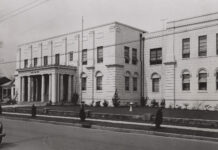
That building dates to approximately 1850 and was originally named for its builder, Jonathan Emanuel, a British-born merchant whose Government Street mansion was destroyed to construct the Admiral Semmes Hotel. However, Mr. Emanuel would not recognize the structure as it stands today.
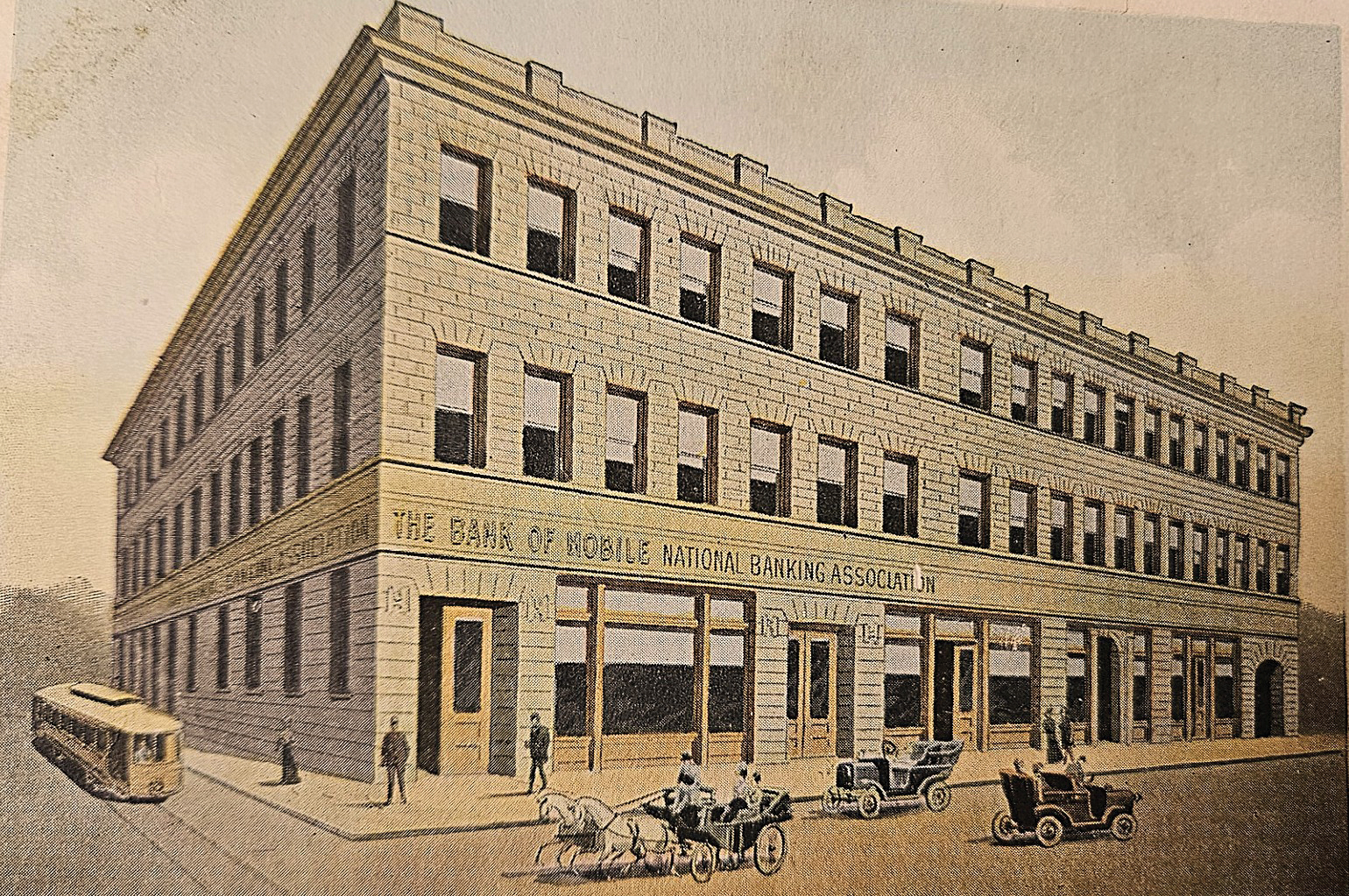
In 1903, newly arrived architect George B. Rogers was called upon to remodel the building for the recently formed Bank of Mobile, the first national bank to be established in Mobile since a 1900 law created that designation. It is unclear why the name was selected since the previous Bank of Mobile closed its doors following the largest run on a bank in the city’s history some 20 years earlier.
Rogers was probably selected after his work in designing a seven-story home for the City Bank on Royal Street a year earlier. In the remodeling of the Emanuel Building, Rogers pulled out all the stops on the exterior as well as the decoration of its interior.
From Severely Plain to Opulent
The building was described by a news reporter as “a solid, severely plain type of ante-bellum architecture” and as a “gloomy, time-stained structure.” The entire facade on St. Michael Street was removed and rebuilt using steel girders. Likewise the Royal Street side was changed and opened up. The frontage was encased in what was termed “very heavy Indiana limestone.” In contrast to the light color of the masonry were solid mahogany doors.
Large “French” plate glass windows were installed and a series of these was fronted by a leather covered window seat stretching 28 feet in length. The main banking lobby was an impressive 50 feet square and the vault was described to be “the most perfect burglar proof receptacle of drill and tool proof material.”
The walls featured a three and a half foot tall wainscoting of marble “resembling onyx.” The teller counter featured mahogany trim beneath cast bronze grills. Three dozen bronze lights with white globes lined the counter. Larger electric lamp brackets, each topped by a bronze eagle, were mounted on the walls. The furniture, which included roll-top desks of solid mahogany and leather covered chairs and wall paneling, were all designed by the architect in a style he termed Italian Renaissance.
Rogers was also responsible for the decorative tiled floor which featured the bank’s name at the entry. The large windows were fitted with venetian blinds with mahogany slats.
In addition to the elegant lighting, the room also held four large ceiling fans and the offices and lobby were equipped with “an inter-communicating telephone system.” Steam radiators were fitted behind solid bronze grills.
Private offices and “a ladies’ waiting room” featured walls and carpets of a soft green and the directors’ room held what was described as “one of the most beautiful (light) fixtures in the South.” Even the restrooms were not spared; their fixtures were of marble.
Swallowed by Competition
The bank lasted until June 30, 1917, when one news account stated that it had been “swallowed by the Peoples Bank.” That was the last time a bank occupied the northeast corner of Royal and St. Michael streets.
For nearly a decade, city directories list the address as holding “The Emanuel Building,” and housing office space. In 1927, it had been renamed the Staples-Powell Building, housing a lumber company by that name operated by Alfred L. Staples and Oliver H. Powell.
A decade later it was renamed as the Staples-Pake Building, and that name is still visible on its facade today. Bart Pake partnered with Mr. Staples to offer real estate and insurance at 100 North Royal Street and an image of the building appeared on advertisements for their business. That firm would have the longest run on this historic corner.
After a long period of neglect, the building has been restored much to its 1904 appearance, and the former bank space now houses the Ruby Slipper Cafe, one of downtown Mobile’s most popular restaurants for breakfast and brunch.