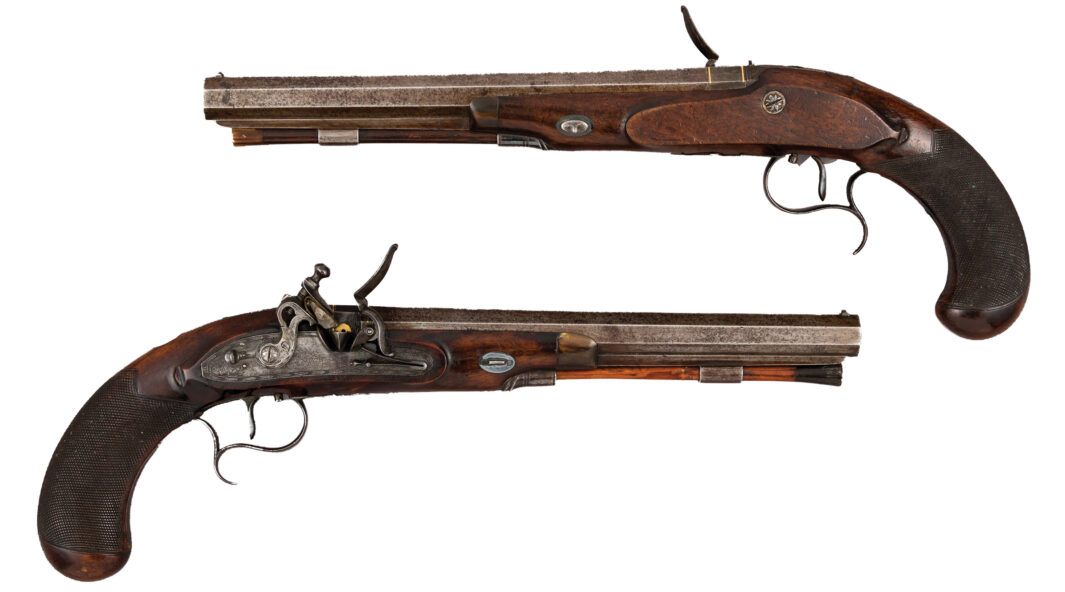
Pair of flintlock dueling pistols circa 1815-1820 made of steel, gold, silver, walnut, hickory and horn // Photo courtesy Wikicommons, from the Metropolitan Museum of Art’s John Stoneacre Ellis Collection.
By the early 1800s, dueling had begun to decline in America, especially in the North. In the South, however, where the chivalrous novels of Sir Walter Scott continued to inspire gentlemen, it stubbornly remained as a logical process designed to defend one’s honor in events of insult or personal grievances. But even before the Civil War, there were many areas in the South that outlawed dueling through ordinances and legislation. Yet its demise was largely due to American public opinion, which held the practice in disdain, and condemned it as cold-blooded murder in a civilized society.
Like other human dramas, Mobile’s last recorded duel had its acrimonious beginnings, raving challenges and tragic consequences. Ironically, the incident began with a dispute between two friends, who were not Mobilians but lived in Vicksburg, Mississippi. The first, Henry Grey Vick, was said to be a handsome young man, about 20 years old, who came from a wealthy family descended from the founder of the city of Vicksburg. His friend, James Stith, about the same age as Vick, was a Virginian, whose father was a descendant of George Washington, and resided with his family in the well-to-do-suburb of east Vicksburg.
The tale of the duel, pieced together from various acquaintances of Vick and Stith, are long-standing, corroborated and believed to be accurate. Henry Vick had invited his friend, Stith, to a house party given at the Vick family plantation a few miles from Vicksburg. There, a quarrel erupted between the two young men over Vick’s overseer, whom Stith accused of rudeness. Stith demanded Vick discipline the overseer for the offense, but Vick declined to take any action against his employee. Maddened with his friend, Stith demanded Vick never to speak to him again. For Vick, the friendship was over, and he was willing to forget the incident and go on with his life. But Stith, taking umbrage, would not forget.
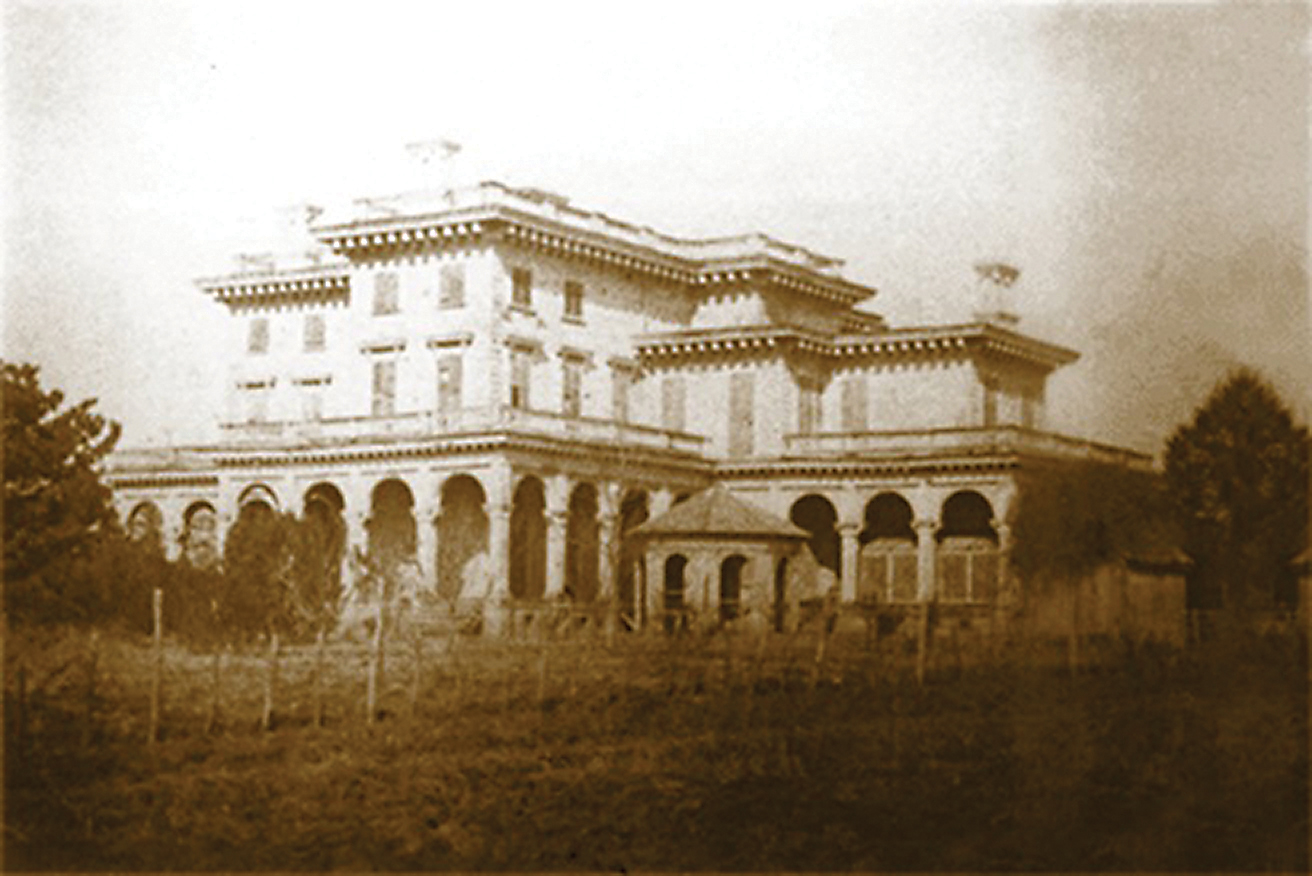
A year passed, during which time Vick’s long engagement to his sweetheart, Helen Johnstone, had finally ripened into the announced wedding date and place: May 21, 1859, at the Chapel of the Cross near Annandale Plantation, home of the bride’s family. A week before the wedding, Vick left Vicksburg for New Orleans, where he planned to select a new suit for the occasion and purchase some items for the home he and Helen would live in after the ceremony. While there, he went into a tavern and joined a group of gentlemen for a drink. His one-time friend, James Stith, then appeared and was invited to join the group. He refused, and turning to Vick, nastily snarled, “Because you are no gentleman.” For Vick, a Southerner, the remark was an insult to a man of the gentry, and could not be tolerated. He lashed out at Stith, who then came at Vick. Vick drew his pistol, and was about to shoot, when his close friend, A.G. Dickinson, grabbed his hand and pulled the pistol away. Enraged, Vick challenged him under the ancient tradition of the code duello, and the red-faced Stith eagerly accepted.
One account claimed that soon after he made the challenge, Vick attempted to apologize to Stith, remembering his promise to his fiancee Helen that he would not participate in a duel. But Stith would not accept the apology. With that, the conditions for the affair were agreed upon: Vick’s seconds would be Dickinson and another friend, Colonel Lockridge; Stith chose two men from Baton Rouge, Tom Morgan and Frank Cheatham; Kentucky rifles, rather than pistols, would be the weapons. They decided the site of the contest should be moved to Mobile, Alabama, which would be far enough away from their homes to keep their families and peers from knowing of their involvement in what was both against the law and public approval. Thus, the group boarded a mail boat in New Orleans bound for Mobile.
It remains unclear exactly where in Mobile the duel was held, although some contend the affair took place in an area known as Holly’s Gardens, a grove on Scott Street just north of Charleston Street. As they aimed at each other from 30 paces apart, the odds were with Vick, who was known to be an excellent shot, while Stith was not. Yet, on May 17, 1859, when the signal was given and the shots fired, Vick missed his mark. The shot sailed over Stith’s head while Stith’s bullet struck Vick directly in the forehead, killing him instantly, only four days before his wedding date with Helen. Afterwards, there was some speculation that Vick missed intentionally, finding it strange that he could hit a running deer with a single rifle shot but somehow missed a still target at 30 paces.
Word that a duel was going to take place was known to the police, although they did not know the time and place it would occur. So as soon as Vick’s body hit the ground, the remaining participants quickly left the scene, knowing the police would be on the way. Stith and his seconds fled to the mail boat, which was returning to New Orleans. Vick’s seconds, Dickinson and Lockridge, did not get there in time. The police began searching for the participants. Vick’s friends were now fugitives. They would have to go into hiding until the next mail boat sailed for New Orleans. Fortunately, Dickinson was acquainted with Dr. Lawrence A. McClesky, who practiced medicine and lived in a brick structure at the southeast intersection of St. Francis and Joachim streets. McClesky kindly offered them shelter until they could board the next vessel.
While at McClesky’s, Dickinson began lamenting the care of his dead friend. The undertaker had custody of the body, but had no instructions for preparing and shipping Vick’s remains home for burial. Dickinson had previously met Captain Harry Maury, Mobile’s chief of police, and decided to send for him and confess everything that had happened. The debonair and bold Harry Maury was no stranger to dueling. In fact, he was a proponent of the practice. Only the year before, he himself had fought and won a duel against Henri Arnous de Riviere, a celebrated French baron. So after hearing Dickinson’s tale, Maury decided to help the two friends escape being captured by his own police force and return home. On Maury’s advice, Dickinson disguised himself and went to the undertaker, giving him instructions for the care and shipment of Vick’s body back to Vicksburg.
Meanwhile, Maury made preparations to get Dickinson and Lockridge back to New Orleans. Shortly before the next mail boat for New Orleans was about to depart, Maury sent a carriage to Dr. McClesky’s to pick up Dickinson and Lockridge, and deliver them to the boat where he managed to smuggle them onboard. The clandestine operation was successful, even under the watchful eyes of the police who were guarding the main gangway. Maury concealed them in one of the state rooms and locked the door. In a final search before the boat was allowed to sail, the police officers believed the men were hidden in the locked state room. But Captain Maury assured his men that some frightened women were the only occupants of the room, and he had advised them to lock the room for protection against the fugitives the police were trying to apprehend. And so it was, the boat set sail, and Vick’s seconds escaped to New Orleans.
News of Vick’s death was not known for several days at the Annandale Plantation where Helen had been blissfully preparing for the wedding. Arrangements had been made to employ a caterer from New Orleans and his crew of waiters and cooks to serve at the reception. They were to be sent by boat to Vicksburg, then on to Annandale in time for the ceremony. But in what proved a most tragic irony, that same boat bound for Vicksburg, carrying the help, food, drink and articles for the wedding, also contained the dead body of the groom, Henry Vick. Yet the caterer was unaware of this until the boat landed in Vicksburg. There, Dickinson and Lockridge had already arrived and brought word of Vick’s death.
Shortly after their arrival, Dickinson and Lockridge left Vicksburg, traveling to the Annandale Plantation just north of Jackson, Mississippi, to inform Helen Johnstone of the dreadful death of her soon-to-be husband. As expected, Helen took the news badly, nearly to hysterics. At her insistence, Vick’s body was brought to Annandale to be buried in the Johnstone family cemetery. The funeral was held at once, and Helen cut off locks of her hair, placing them in the coffin on the body of her dead lover. Later, she placed bronze statues of Vick’s hunting dogs near the grave, along with an iron bench where she would sit for hours mourning Henry Gray Vick, who died in what is believed the final duel held in Mobile, Alabama.
Russell W. Blount Jr. is the author of five books on the American Civil War as well as a number of articles on 19th-century America in historical journals and publications.