Mobile enjoyed active theatrical seasons beginning as early as the 1830s, and the city was visited by many famous actors, including Bernhardt. However, none of them had quite the experience here that “the incomparable one” (as she was dubbed by Oscar Wilde) had during her 1881 visit.
Sarah Bernhardt, born Henriette-Rose Bernard in 1844, was the offspring of a Dutch courtesan and her lover, a French attorney. She was sent to an Augustine convent school near Versailles and, for a time, considered a future as a nun. Perhaps she changed her mind when she was accused of sacrilege for performing a Christian burial for her pet lizard.
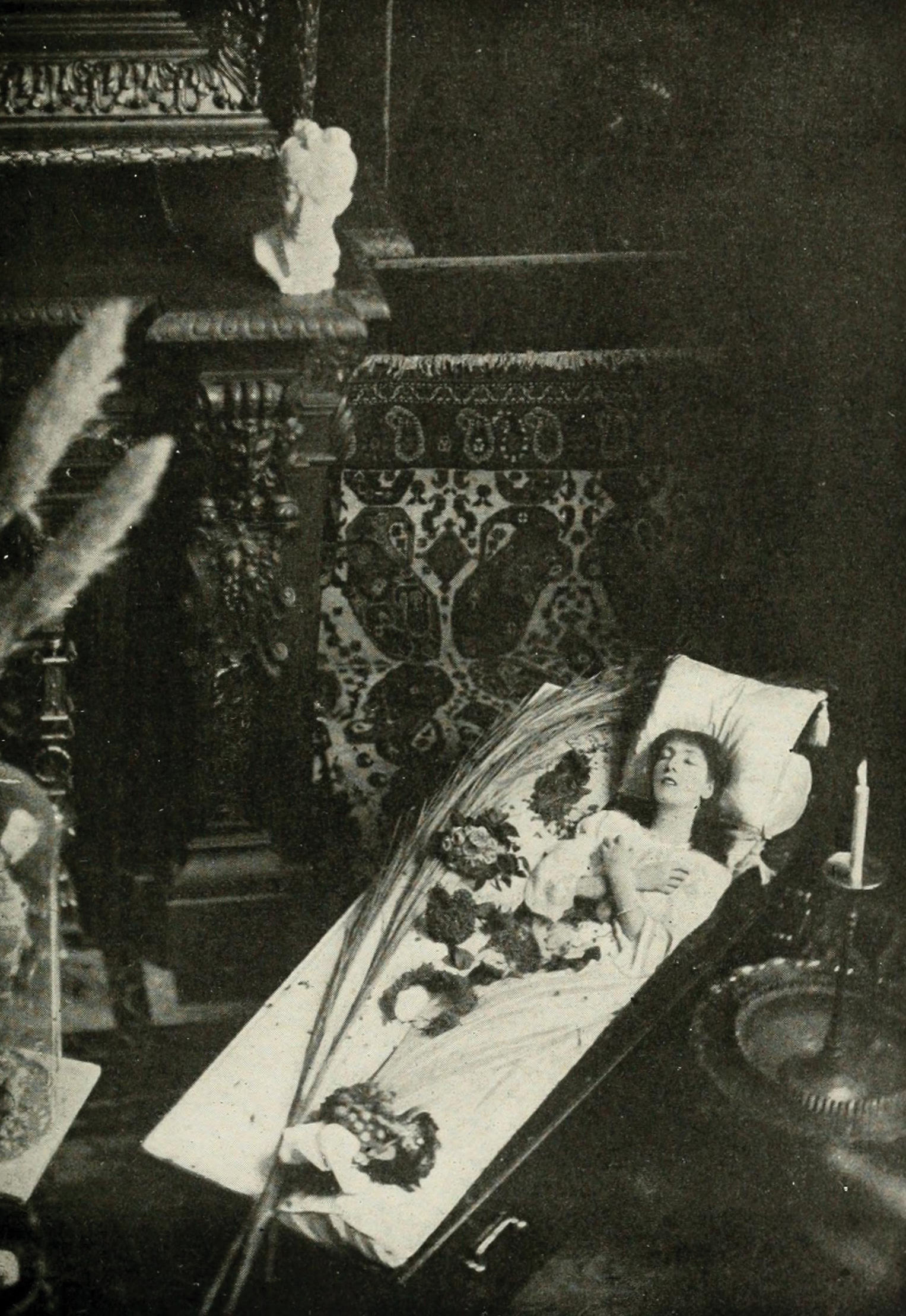
During the 1860s, her stage experience grew, and by the next decade, she was one of the highest paid actresses in Paris. As her fame grew, so did her expenses. By the late 1870s, she had built a Parisian mansion staffed by eight servants. She had her bedroom fitted with a satin-lined coffin in which she occasionally slept. Sarah, who some have termed “the first modern celebrity,” even had herself photographed in it.
By the late 1870s, her cost of living was outpacing her income. In 1879, she arranged her first London tour, and the curious audience packed the theater to see her performance in La Dame aux Camellias. There was not a dry eye in the house when her character died in the closing scene. She made even more money with her private performances within the mansions of British nobility.
While living in London, she added to her personal menagerie by obtaining three dogs, a parrot, a monkey, a cheetah and six chameleons. All moved with her back to Paris.
Scandal Sells
During 1880-81, she toured the United States and Canada with her troupe, domestic staff and some 100 pieces of luggage. There were a total of 157 performances in 51 cities. In New York City, she made 27 curtain calls after one of her performances. However, she was ignored by New York society, who found her private life scandalous.
Various members of the clergy condemned her as immoral and “the monster of the apocalypse.” The more they roared about her, the more the public clamored to see her. She demanded $1,000 per performance and 50% of the box office receipts when they surpassed $4,000. And all was to be paid to her in cash.
After a single performance in New Orleans, Miss Bernhardt arrived in Mobile on February 7, 1881. Her train car was surrounded by a crowd that was calling her name and knocking on the windows as she tried to nap. She later recalled, “I quickly threw up a window and emptied a jug of water on their heads. Women and men and several journalists were splashed. Their fury was great.”
To make matters worse, Mobile’s grandest theater had been double-booked and a replacement had to suddenly be found for her performance and the expected crowd.
A Miserable Place
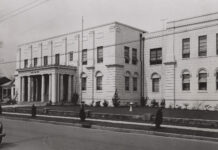
They chose Temperance Hall, which had stood on the northeast corner of St. Joseph and St. Michael streets since 1854 and had been erected “to the holy cause of Temperance.” Its third floor held a concert hall which could seat 1,200 and seemed an ideal location for the event.
The “Divine Sarah” was not pleased. As the packed house awaited the curtain to rise, they heard a growing commotion behind it. Miss Bernhardt was staging a monumental tantrum and her shrieks could be clearly heard by the audience.
The actress later described the venue as “a miserable place, so small that I know nothing that can be compared to it.” The scenery included a doorway through which servants in the play were to bring a meal to the seated diners. In attempting to get through the narrow passage, something caught on the scenery, and as the actress would later say, “the whole back scene fell on our heads and remained there. Our heads went through the paper, and the appearance was most comical and ridiculous.”
After the theatergoers witnessed yet another tantrum from the actress, they were offered a refund and Miss Bernhardt happily left the Port City. She would return to Paris with a chest containing $194,000 in gold coins. That sum would equal about $6.2 million today.
Sarah Bernhardt died in Paris in 1923 at the age of 78. That same year, Mobile’s Temperance Hall was demolished for an office building.